
Fried Plantain, Drones and Control Systems
The Algorithm Running Your Factory: PID Control and Why African Engineers Need to Own It
There is an algorithm quietly running inside nearly every industrial process on the planet — regulating temperature in a Coca-Cola bottling plant, maintaining pressure in an oil refinery, stabilising a drone mid-flight, and in more advanced applications, guiding missile defence systems. It is called the PID controller, and most African engineers never go deep enough on it to be able to design, tune, or improve one from scratch.
That gap is exactly what Dapo set out to address in a recent Africa Deep Tech Community session. A certified automation professional and control systems engineer, Dapo has spent years working to bridge the distance between how control systems are taught in African universities and how they actually function in industry. The session drew on that experience to make a technical subject accessible — and to make a broader argument about what African engineers stand to gain by taking it seriously.

What PID Actually Means
PID stands for Proportional, Integral, Derivative — the three mathematical components that make up the control algorithm. In practical terms, a PID controller watches a process (say, the temperature inside a tank), compares it to a target value, and continuously calculates corrections to minimise the gap between the two.
Dapo used the analogy of cooking plantains to illustrate the concept: the cook observes how the plantain is browning, adjusts the heat, and responds to how quickly things are changing. As many Africans know, a few seconds at the wrong temperature could make the difference between an amazing meal of delicious golden brown fried plantains and ruined dreams. Dapo let us know that it is indeed possible to leverage PID in regulating the oil temperature to ensure that you get the best fried plantain on time every time. A PID controller does the job with a level of precision a human hand cannot match.

The three components each handle a different dimension of that correction. The proportional term responds to the current error — how far off the process is right now. The integral term accounts for accumulated error over time, catching persistent drift that the proportional alone would miss. The derivative term responds to the rate of change — anticipating where the process is heading before it gets there.
The Stakes Are Higher Than They Look
The Coca-Cola bottling example Dapo used was well chosen. In a high-speed production environment, PID loops maintain the consistency that keeps every bottle within specification. Get it wrong — overfill, underfill, incorrect temperature, wrong pressure — and the consequences range from product waste to safety failures to legal liability. The algorithm is not an abstraction; it is directly connected to the quality of what comes off the production line.
The energy dimension is equally significant. Dapo cited research indicating that properly tuned PID algorithms can deliver energy savings of between 5 and 15 percent. He referenced IHS data showing energy at 39.2 percent of cost of sale in 2024 — which means that for energy-intensive industries, better control engineering is not just a technical improvement, it is a financial one.
Africa’s Dependency Problem
The harder point Dapo made was about where African industry currently stands. Many companies across the continent, he explained, are running processes on pre-programmed controllers supplied by foreign manufacturers — systems that come configured, sealed, and essentially opaque to the engineers who operate them. When something goes wrong or needs to be optimised, the expertise has to be imported along with the fix.
He pointed to the oil and gas sector as a concrete example. Importing control engineering expertise for major projects has resulted in substantial additional costs and delays. The Dangote refinery was cited as a case where Nigerian engineers, given the right capability, could contribute meaningfully — and where the absence of that local capability has a direct and measurable cost.
The argument is not that African engineers are unqualified. It is that the training pipeline, from university to industry, is not equipping them to design and tune control systems from first principles rather than simply operating what someone else has already built.
Tuning Is Where the Real Knowledge Lives
One of the session’s most useful sections was the demonstration of what tuning actually involves and why it matters.
Dapo walked through how different tuning strategies affect the behaviour of a control system, using a simulated temperature controller. Aggressive tuning — setting the parameters to respond quickly and forcefully to error — reduces the gap between actual and target values faster, but causes oscillation: the system overshoots, corrects, overshoots again. In a food production environment, that kind of oscillation can mean product loss. In a more hazardous process, the consequences are more serious.
Conservative tuning produces a slower, more stable response — less overshoot, but a longer recovery time after a disturbance. Neither approach is universally correct. The point is that understanding what each parameter does, and why, is what allows an engineer to make the right call for a specific application. That judgment is what cannot be pre-programmed into an imported controller.
Dapo also introduced a separator tank simulator he is currently developing, which demonstrates oil production processes and the various control loops that govern them — a practical tool for training engineers on industrial applications without needing access to real plant equipment.
Where AI Fits — and Where It Doesn’t
The session’s closing discussion addressed a question that has become unavoidable across engineering fields: what does AI mean for control systems?
Dapo’s position was measured. Generative AI tools can assist engineers by breaking down complex processes, parsing large volumes of sensor data, and helping to model system behaviour — he mentioned Claude as an example of how AI can serve as a support layer for experts. In applications like drone control and home automation, AI is already enhancing how decisions are made in real time, drawing on historical records and live sensor inputs to improve outcomes.
But he was clear about the limits, particularly in safety-critical environments. Oil and gas, high-temperature industrial processes, and other hazardous applications are not domains where AI replaces the engineer’s judgment. The stakes of a bad decision are too high, and the variability of real-world conditions too complex, for automated systems to operate without trained human oversight.
Mogaji raised an idea that generated real discussion: training specialised language models in 3D simulated environments to develop an understanding of real-world physics and industrial processes. The concept — which Chukwuemeka summarised as building a process-specific “brain” that could serve as a digital twin for a particular industrial setup — points toward where the field may be heading, particularly for lower-stakes applications where the cost of error is manageable.
Making the Knowledge Accessible
Dapo’s training platform, SkillKatalyst, is his practical response to the gap he identified. With a community of nearly 700 professionals and a university-level course on servo mechanisms, the platform combines visual simulations, mathematical models, and project-based learning to teach control systems concepts in a way that connects theory to application.
The platform allows users to simulate different tuning scenarios and observe how a process responds to disturbances — giving engineers the ability to develop intuition for system behaviour without the risk of getting it wrong on live equipment.
Beyond training, Dapo made the case for affordable automation solutions tailored to the African market. Many small and medium enterprises on the continent cannot access or afford the kind of industrial controllers used in large-scale plants. Custom controller boards built on existing architectures — ARM processors and common microcontrollers — offer a viable path to bringing control engineering capability to a much wider range of operators. Combined with low-cost simulators and accessible learning tools, the building blocks for scaling this knowledge exist. What is needed is the commitment to develop them locally.
The Broader Point
The argument running through the entire session was consistent: deep technical knowledge — the kind that allows an engineer to design, tune, and improve a system rather than simply operate it — is not a luxury. It is the foundation on which industrial capability is built.
PID controllers are one layer of that foundation. They are not exotic or cutting-edge; they are standard. And that is precisely the point. The gap between knowing that PID controllers exist and being able to work with them fluently is where a great deal of African engineering capability is currently stuck. Closing that gap, sector by sector, is part of what the Africa Deep Tech community is working toward.
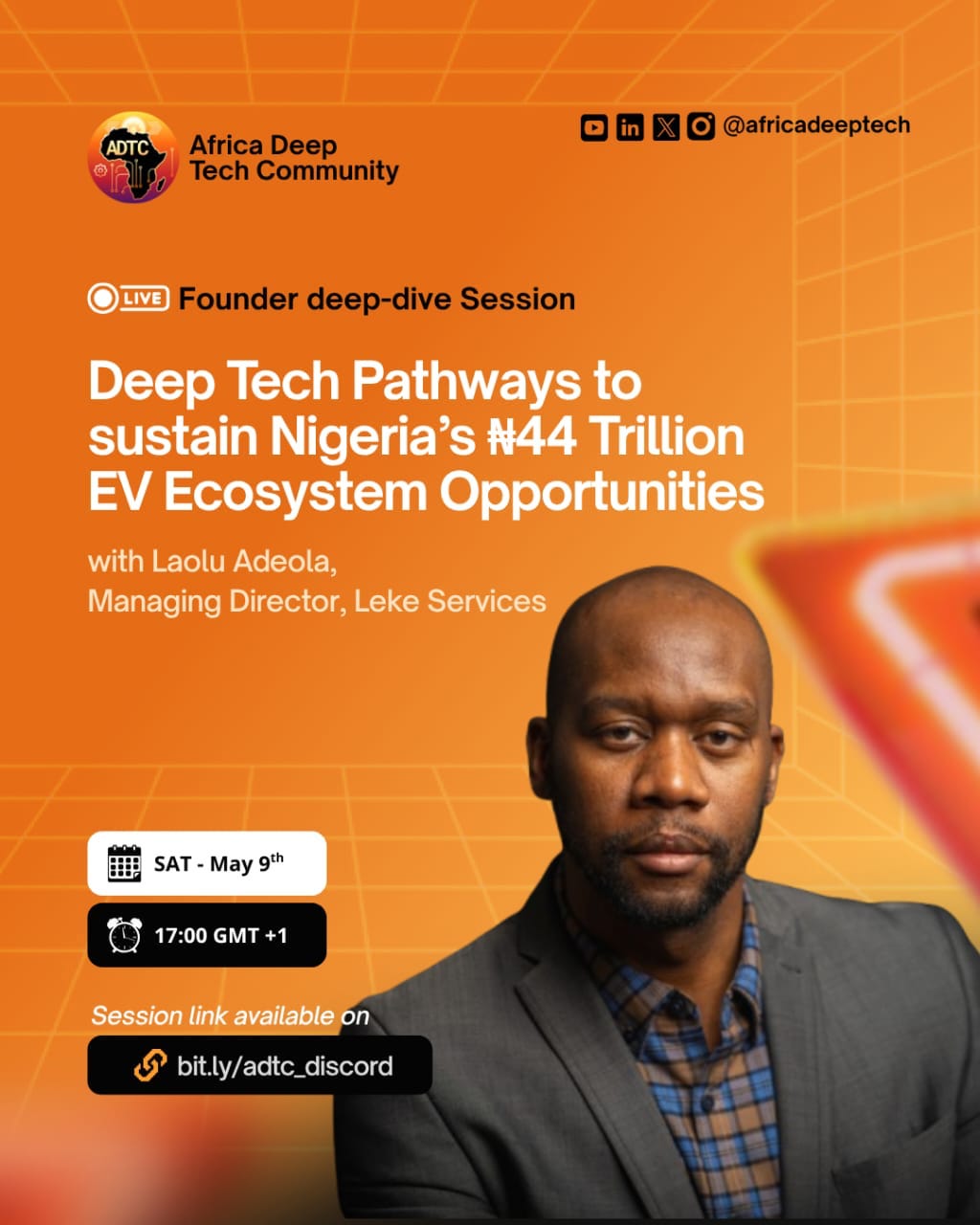
Join us this Saturday for a Founder Deep Dive Session
Want to be part of these conversations? Join the Africa Deep Tech Community on Discord: bit.ly/ADTC_Discord
Join us for unfiltered insights from Laolu Adeola, Founder & Managing Director at Leke Services, a boutique consultancy guiding leaders through mobility energy transitions. Ex-McKinsey Center for Future Mobility scholar, he's electrified strategies for batteries, EVs, and emissions reduction.
Date: May 9, 2026
Time: 17:00 GMT+1
Session highlights:
- Nigeria's EV edge: Transport boom, power hurdles, fuel spikes
- 4-layer ecosystem: Vehicles, charging, fleets, enablers
- Deep tech's local scale role (beyond imports)
- Specialized, scalable models over full verticals
Elevate your deep tech game in Africa's mobility revolution.
Want to be part of these conversations? Join the Africa Deep Tech Community on Discord: bit.ly/ADTC_Discord